Remote Staffing for UK Companies: Hire Pre-Vetted Talent at 75-85% Less
On 31 December 2020, the UK lost frictionless access to the largest talent market on its doorstep. Five years later, this is not a temporary disruption — it is a permanent structural shift in how British companies can and cannot hire. The Skilled Worker visa regime has turned what used to be a simple hiring decision into a multi-thousand-pound compliance exercise. Salary thresholds have risen. Employer NICs have increased. And the EU pipeline that once quietly supplied a fifth of UK tech talent has effectively closed for any company without a sponsorship licence. This guide is not a generic "remote staffing saves money" article. It is a post-Brexit talent strategy for UK companies that need to build engineering capacity without the cost, timeline, or regulatory overhead that now defines domestic hiring.
Key Takeaways
- Brexit permanently closed the EU talent pipeline — Skilled Worker visas now cost GBP 1,000-2,000 per worker with a GBP 38,700 salary floor, making sponsorship uneconomical for most SMEs
- A London developer at GBP 85,000/year fully loaded costs the same as 4-5 managed remote hires through Nexoforma at $1,499-$2,499/month each
- IR35 off-payroll rules are a non-issue with managed remote staffing — the engagement is a B2B services agreement, structurally outside the IR35 framework
- GMT is the best timezone in the world for remote staffing — 4-6 hours of natural overlap with both the US East Coast and South Asia, plus near-full coverage of Europe and Africa
- Nexoforma delivers matched candidates in 48 hours with UK GDPR-compliant data handling, IP assignment under English law, and a free replacement guarantee
Remote staffing for UK companies is a post-Brexit hiring strategy where British businesses engage pre-vetted remote employees through a managed staffing provider instead of competing in a constrained domestic labour market or navigating the Skilled Worker visa regime. The provider handles recruitment, vetting, payroll, compliance, and HR, while the UK company retains full operational control. This model bypasses visa costs, avoids IR35 complications, maintains UK GDPR compliance, and delivers talent at 75-85% less than local hiring — with timezone-aligned working hours and a free replacement guarantee.
What Brexit Actually Did to UK Tech Hiring — and Why It Is Permanent
Before 31 December 2020, a Romanian developer, a Polish data engineer, or a Spanish UX designer could accept a job offer in London on Monday and start work on Wednesday. No visa. No sponsorship. No salary threshold. Freedom of movement meant that 447 million EU citizens were part of the UK's available talent pool — and roughly 15-20% of UK tech workers were EU nationals taking advantage of that access.
That ended overnight. The Transition Period expired, and the UK moved to a points-based immigration system that treats EU citizens the same as anyone else. The practical consequences for UK employers are severe and structural:
Skilled Worker Visa Costs Are Prohibitive for SMEs
Sponsoring a single overseas worker now requires a Sponsor Licence (GBP 536 for small companies, GBP 1,476 for medium/large), a Certificate of Sponsorship (GBP 239), and an Immigration Skills Charge (GBP 364/year for small companies, GBP 1,000/year for large). The worker themselves pays GBP 1,035-1,084 in visa fees plus the Immigration Health Surcharge at GBP 1,035/year. Total cost per hire: GBP 1,000-2,000+ in the first year alone, before the worker has written a single line of code. For a startup hiring three engineers, that is GBP 3,000-6,000 in immigration costs on top of salaries.
The GBP 38,700 Salary Threshold Eliminates Early-Career Hiring
As of April 2024, the general salary threshold for Skilled Worker visas rose from GBP 26,200 to GBP 38,700. This effectively eliminates visa sponsorship for junior and many mid-level roles outside London. A startup in Manchester or Bristol cannot sponsor a junior developer at GBP 30,000 — even if the candidate is technically qualified and willing. The system is designed for large employers hiring senior professionals, not for growth-stage companies building teams.
The Net Effect: a Smaller, More Expensive Talent Pool
According to the Migration Observatory at Oxford, net EU migration to the UK for work dropped by over 80% between 2019 and 2023. The tech sector felt this disproportionately. Companies that once hired EU nationals with a simple employment contract now face a choice: pay GBP 60,000+ for domestic talent in a compressed market, spend GBP 1,000-2,000+ sponsoring an overseas worker through a 3-6 month visa process, or find a different approach entirely. Remote staffing is that different approach.
The structural point: this is not cyclical. There is no political pathway back to EU free movement. Both major UK parties have ruled it out. The Skilled Worker visa regime will get tighter, not looser — the April 2024 salary threshold increase proved that. Any talent strategy built on the assumption that the pre-2021 labour market will return is a strategy built on a fantasy.
The GBP 85,000 Developer vs. the $1,800/Month Alternative
Here is a story that plays out hundreds of times a month across British tech companies. A Series A startup in Shoreditch needs a mid-level full-stack developer. They post the role on LinkedIn and receive 200 applications, of which perhaps 15 are genuinely qualified. After three rounds of interviews, two technical assessments, and six weeks of calendar coordination, they make an offer.
The base salary: GBP 65,000. But that is where the maths starts, not where it ends.
Employer National Insurance contributions, raised to 15% on earnings above GBP 5,000 in April 2025, add roughly GBP 9,000. Auto-enrolment pension at 3% minimum adds GBP 1,950. Equipment, software licences, and cloud development environments run GBP 2,500-4,000. The recruitment agency that sourced the candidate charges 20% of annual salary: GBP 13,000, payable regardless of whether the hire works out. By the time the developer has pushed their first commit, the company has spent approximately GBP 85,000-95,000 in year-one total cost of employment.
Now consider the alternative. The same company engages a pre-vetted, AI-trained full-stack developer through Nexoforma at $1,499/month. That is approximately GBP 1,200/month or GBP 14,400/year. The fee includes recruitment, vetting, payroll, compliance, equipment, AI training, and a free replacement guarantee. No employer NICs. No pension obligations. No agency fee. No visa costs.
For the cost of that single London hire, the startup could engage four to five managed remote developers through Nexoforma — and still have budget left over.
Total Employment Cost by UK Region — Mid-Level Developer (2026)
| Location | Base Salary (GBP) | Employer NICs (15%) | Pension + Benefits | Total Annual Cost |
|---|---|---|---|---|
| London (Zone 1-2) | GBP 65,000 — 75,000 | GBP 9,000 — 10,500 | GBP 4,000 — 6,500 | GBP 78,000 — 92,000 |
| Manchester | GBP 50,000 — 60,000 | GBP 6,750 — 8,250 | GBP 3,500 — 5,000 | GBP 60,250 — 73,250 |
| Edinburgh | GBP 48,000 — 58,000 | GBP 6,450 — 7,950 | GBP 3,400 — 4,800 | GBP 57,850 — 70,750 |
| Bristol / Birmingham | GBP 45,000 — 55,000 | GBP 6,000 — 7,500 | GBP 3,200 — 4,500 | GBP 54,200 — 67,000 |
| Nexoforma (Managed Remote) | All-inclusive flat rate: $1,499 — $2,499/month | GBP 14,400 — 24,000 | ||
Total cost includes employer NICs at 15% (April 2025 rate), auto-enrolment pension (3%+ employer contribution), standard benefits, and typical equipment/software costs. Recruitment agency fees (15-25% of salary) NOT included — add GBP 7,000-18,750 for first-year hires through agencies. Nexoforma pricing includes recruitment, vetting, payroll, compliance, AI training, equipment, and free replacement guarantee. GBP at 1 USD = 0.80 GBP (April 2026). View full pricing →
Even outside London, the savings are dramatic. A developer in Bristol or Birmingham at GBP 55,000 base still costs GBP 65,000+ fully loaded — roughly four times the cost of a managed remote hire. The argument that "salaries are cheaper outside London" misses the point: the structural costs (NICs, pension, recruitment fees, replacement risk) follow you everywhere in the UK. Remote staffing eliminates all of them.
The recruitment fee alone tells the story: a typical UK agency charges 15-25% of annual salary per placement — GBP 8,250-18,750 for a mid-level developer. That is non-refundable even if the candidate leaves during probation. For the cost of a single agency placement, you could fund 5-12 months of managed remote staffing through Nexoforma, with a free replacement guarantee that the agency does not offer.
IR35: Why It Is a Non-Issue with Managed Remote Staffing
IR35 is the single most common objection UK buyers raise when considering remote staffing. It is also the most misunderstood. Since the off-payroll working rules were extended to the private sector in April 2021, UK companies have been rightly cautious about how they engage anyone who is not a direct employee. HMRC's enforcement has been aggressive, and the penalties for getting it wrong are severe.
But IR35 anxiety about managed remote staffing is based on a category error. Here is why.
What IR35 Actually Targets
IR35 applies when an individual contractor provides personal services through an intermediary — typically a Personal Service Company (PSC) — and the relationship would be one of employment if the intermediary were removed. The off-payroll rules require the end client (your company) to determine the contractor's employment status using HMRC's CEST tool. If the determination is "inside IR35," you must deduct income tax and NICs at source.
Why Managed Staffing Is Structurally Outside IR35
When you engage Nexoforma, you are entering a B2B services agreement with a managed staffing company. The remote worker is employed by Nexoforma — not engaged as an individual contractor to your company and not operating through a PSC. There is no personal service contract between your company and the worker. There is no intermediary to "look through." HMRC's CEST tool is not required because the engagement does not meet the threshold conditions for IR35 to apply in the first place.
Contrast with UK Contractor Hiring
Consider the alternative: hiring an individual contractor through their Ltd company or a recruitment agency that does not employ the worker directly. In both cases, you must run a CEST determination, assess mutuality of obligation, evaluate right of substitution, and document your reasoning. If HMRC disagrees with your determination, your company is liable for unpaid tax and NICs plus penalties. This uncertainty has made many UK companies abandon contractor hiring entirely. Managed remote staffing eliminates this entire category of risk.
Your legal team can confirm the IR35 position in a single meeting. The engagement structure is clear: your company has a B2B services contract with Nexoforma. Nexoforma has an employment relationship with the remote worker. Your company has no contractual relationship with the worker as an individual. IR35 does not enter the picture.
UK GDPR After Adequacy: What Is Actually Required for Cross-Border Teams
Post-Brexit, the UK operates its own data protection regime under the Data Protection Act 2018, as amended by the Data Protection and Digital Information Act 2025. The UK is no longer automatically covered by the EU's data protection framework — but the EU has granted the UK an adequacy decision, meaning data can flow between the UK and EU without additional safeguards. For transfers to countries outside both the UK and EU, specific mechanisms are required.
International Data Transfer Mechanisms
When UK personal data is processed by remote staff outside the UK and EU, UK GDPR requires one of three transfer mechanisms: an adequacy decision for the recipient country, the UK International Data Transfer Agreement (IDTA), or the UK Addendum to EU Standard Contractual Clauses (SCCs). For most remote staffing arrangements involving South Asian talent, the IDTA or UK Addendum to SCCs is the applicable mechanism. Nexoforma includes IDTA-compliant data processing agreements as standard for every UK client engagement.
Practical Data Handling for Remote Teams
Compliance is not just a contract — it requires practical measures. Nexoforma implements technical and organisational safeguards including: encrypted communication channels, role-based access controls limiting remote workers to only the data necessary for their function, VPN and endpoint security requirements, data minimisation policies, and 72-hour breach notification procedures. For FCA-regulated clients, additional controls (audit logging, data residency restrictions, enhanced access review) are configured before the first working day.
IP Assignment Under English Law
All work product created by Nexoforma-placed staff is assigned to the client via comprehensive IP assignment clauses governed by English law. NDAs are standard for every placement. Your company retains full ownership of source code, designs, documentation, and derivative works. The legal effect is identical to employing a local developer under a standard UK employment contract — without the employment relationship or associated obligations.
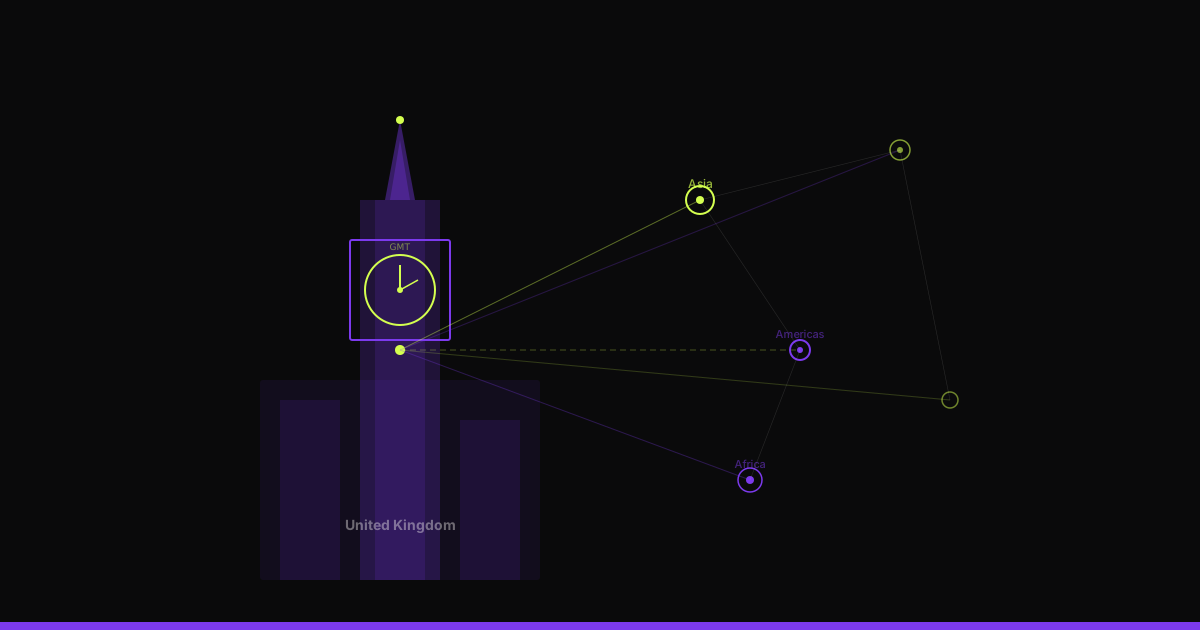
Why GMT Is the Best Timezone for Remote Staffing in the World
This is not hyperbole. The UK's position at UTC+0 (GMT) or UTC+1 (BST) gives it a genuine competitive advantage over every other major market when it comes to remote team management. Here is why.
A US company hiring remote developers in India faces a 10.5-13.5 hour timezone gap. Real-time collaboration requires one side to work at genuinely antisocial hours. An Australian company faces a similar problem in the opposite direction. A Japanese company working with South American talent is dealing with near-complete timezone inversion.
The UK sits in the middle of everything. Consider the natural overlaps:
GMT/BST Overlap with Global Talent Regions
| Talent Region | Gap from GMT | Natural Overlap | With Shift |
|---|---|---|---|
| Eastern Europe (PL, RO, UA) | +1 to +2 hours | 7-8 hours | Full overlap (no shift needed) |
| Africa (NG, KE, ZA, EG) | +1 to +3 hours | 6-8 hours | Full or near-full overlap |
| South Asia (IN, PK, BD) | +4.5 to +5.5 hours | 3-4 hours | 6-8 hours (12:30-20:30 IST) |
| US East Coast | -5 hours | 4-5 hours | Afternoon UK = Morning US |
| Southeast Asia (PH, VN) | +7 to +8 hours | 1-2 hours | 5-6 hours (with shift) |
Nexoforma aligns remote staff to client timezone by default. Full GMT/BST schedules (9:00-17:00 UK time) available on request. The UK's UTC+0/+1 position provides the widest timezone alignment window of any major market.
A South Asian developer working a shifted schedule (12:30 PM to 8:30 PM IST) covers the UK workday from 8:00 AM to 4:00 PM GMT — eight hours of fully synchronous collaboration. During British Summer Time, the overlap shifts by one hour but remains at 7-8 hours. This is the configuration most Nexoforma UK clients use.
But the real advantage is broader than just South Asia. Because GMT sits between the US East Coast and the Indian subcontinent, UK companies can build teams that provide near-24-hour coverage without anyone working unreasonable hours. Morning standups with Indian developers. Afternoon handoffs to US-based product managers. The UK is the natural coordination hub for global distributed teams — a geographic advantage that no other English-speaking market can match.
And unlike German or Japanese companies that need to assess English proficiency as a separate hiring criterion, UK companies can assume professional English fluency as a baseline. Nexoforma pre-vets all candidates for English communication before they enter the matching pool.
The Roles British Companies Are Hiring Remotely — and the Ones They Should Not
Remote staffing works exceptionally well for knowledge work that can be defined, managed, and reviewed through digital tools. It does not work for everything. Understanding the boundary is critical.
High-Demand Remote Roles for UK Companies
These are the roles British companies hire most frequently through managed remote staffing, ranked by demand volume from Nexoforma's UK client base:
Top Remote Roles for UK Companies — Demand & Pricing
| Role | UK Local Cost (GBP/yr) | Nexoforma (USD/mo) | Savings |
|---|---|---|---|
| Full-Stack Developer | GBP 65,000 — 92,000 | $1,499 — $2,499 | ~78% |
| React / Next.js Developer | GBP 60,000 — 85,000 | $1,499 — $2,499 | ~78% |
| DevOps / Platform Engineer | GBP 75,000 — 105,000 | $1,999 — $2,499 | ~75% |
| AI / ML Engineer | GBP 85,000 — 120,000 | $2,499 | ~75% |
| Digital Marketing Manager | GBP 45,000 — 65,000 | $1,499 — $1,999 | ~80% |
| Executive / Virtual Assistant | GBP 30,000 — 45,000 | $1,499 | ~85% |
| Accountant / Bookkeeper | GBP 35,000 — 55,000 | $1,499 | ~82% |
| QA / Test Engineer | GBP 45,000 — 65,000 | $1,499 — $1,999 | ~80% |
UK costs include employer NICs (15%), auto-enrolment pension (3%+), and standard benefits. London rates shown; outside London deduct 10-20%. Nexoforma pricing includes recruitment, vetting, payroll, compliance, AI training, and free replacement guarantee. View full pricing →
What You Should Not Outsource
Honesty about limitations builds trust. These are the roles and functions where remote staffing is not the right answer for UK companies:
- FCA-regulated roles requiring UK residency — certain Senior Management Functions (SMFs) and Certification Functions under the Senior Managers and Certification Regime require the individual to be based in the UK. Compliance officers, MLROs, and individuals performing controlled functions typically cannot be offshore.
- Government contracts with security clearance — roles requiring SC (Security Check) or DV (Developed Vetting) clearance under the National Security Vetting framework must be performed by UK nationals or residents who have undergone the vetting process. Remote workers in other countries cannot obtain UK security clearance.
- Physical-presence roles — laboratory work, on-site healthcare, physical retail, warehouse operations, or any role requiring hands-on interaction with UK-based equipment, facilities, or customers.
- Roles requiring NHS data access under strict Data Security and Protection Toolkit (DSPT) requirements — while remote access is technically possible, the compliance burden is significant and may not be practical for managed staffing arrangements. Evaluate on a case-by-case basis with your Data Protection Officer.
Everything else — software development, data engineering, QA, DevOps, digital marketing, design, analytics, bookkeeping, customer support, project management — is well-suited to managed remote staffing. UK fintech companies are the fastest-growing segment, with typical engagements involving Dedicated Pods of 3-5 specialists at pod pricing starting at $5,999/month for the entire team. That is less than the fully loaded cost of a single mid-level developer in Shoreditch.
How 90+ Companies Hire Through Nexoforma — the Actual Process
Most UK companies go from first enquiry to a developer pushing code within two weeks. That is not a marketing claim — it is the median timeline across our UK client base. Here is what the process actually looks like, based on how real British companies use the service.
It starts with a 15-minute conversation or a brief submitted through our intake form. You describe the role, the technical requirements, the seniority level, and your preferred working hours. If you have compliance requirements — FCA data handling, PCI DSS, ISO 27001 — mention them here. Nexoforma's team uses this to query the pre-vetted talent pool, which consists exclusively of candidates who have already passed multi-stage technical assessments, professional English evaluation, and AI workflow certification.
Within 48 hours, you receive 2-3 candidate profiles. Not CVs scraped from a job board — detailed profiles with work samples, technical assessment scores, English proficiency ratings, and confirmed availability for GMT-aligned schedules. Each candidate has been through Nexoforma's vetting process before they ever appear in your inbox.
You interview the candidates using whatever process your team already uses — video call, live coding, pair programming, take-home task. You make the hiring decision. Nexoforma does not place candidates you have not approved.
Once you select a candidate, Nexoforma handles all the operational complexity. The UK GDPR-compliant IDTA, the NDA, the IP assignment agreement, the employment contract with the remote worker — all of it is executed before day one. Your new team member is onboarded onto your tools (Slack, Jira, GitHub, Linear, whatever your stack is) with role-based access controls configured. No IR35 determination needed. No visa paperwork. No employer NIC calculation.
From that point forward, you manage the work exactly as you would with a local hire. Daily standups, sprint planning, code reviews, 1:1s — whatever your team's cadence is. Nexoforma handles payroll, performance monitoring, equipment, ongoing AI training, and HR administration in the background. If the placement is not right at any point, the free replacement guarantee kicks in immediately. No notice period, no additional cost, no questions asked.
Timeline comparison: a typical UK recruitment agency takes 6-12 weeks to fill a mid-level developer role. Nexoforma delivers matched candidates in 48 hours and completes onboarding within 1-2 weeks. For UK companies that need to ship product, that 4-10 week difference is not just convenient — it is competitive advantage.
Frequently Asked Questions
Is remote staffing legal for UK companies?
Has Brexit made remote staffing more relevant for UK companies?
Does IR35 apply to remote staffing through a managed provider?
What about employer NICs — do I pay those on remote staff?
How does UK GDPR apply when remote staff handle customer data?
Can I hire through Nexoforma if my company is FCA-regulated?
How quickly can a UK company hire remote staff through Nexoforma?
Ready to Build Your Remote Team?
Tell us the roles you need filled. We will send you matched, pre-vetted candidate profiles within 48 hours — with a full cost comparison vs. your current UK hiring costs.
Our editorial team combines hands-on remote staffing experience with deep market knowledge across the USA, UK, Europe, Canada, Australia, New Zealand, Singapore, Japan, and the Middle East. Every article is informed by real placement data from 600+ active remote professionals and direct client feedback from 90+ organizations worldwide.